
Scales
Part of the Music honor.
Scales are an important building block of music. They are the basis of melodies and chords. Without knowing your scales, you are like a car mechanic without his tools.
What are scales? A good way to define a scale is to list the following characteristics:
- A scale is an organized series of pitches
- A scale utilizes sharps and flats, when necessary
- A scale consist of a series of notes that differ in sound
- A scale is linked to the concept of “Keys” in that a song which utilizes a given scale is said to be in that key (For example: “Mary had a little lamb in C major”).
A major scale has 8 tones. The (C major scale) is: C-D-E-F-G-A-B-C.
These notes in the major scale form a pattern of steps between notes called whole tones, or semitones. On a piano keyboard semitones are from key to key with no keys in between, whole tones always skip a key with one key in between.
The major scale is made up of a pattern of two whole tones, followed by a semitone, followed by three whole tones, ending with one more semitone.
This illustration shows the difference between whole tones and semitones on a piano keyboard.
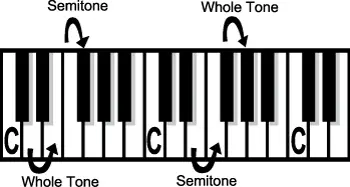
Notice how the whole tones skip a key on the keyboard, and semitones do not. Also you can see that two semitones makes up a whole tone. Whole tones and semitones are types of intervals.
The natural minor scale has a whole tone semitone pattern of whole tone, semitone, whole tone, whole tone, semitone, whole tone, whole tone.
Other scales such as melodic minor, harmonic minor, pentatonic, and whole tone have different patterns of whole tones and semitones.
Adapted from AY Honors/Music/Scales on the Pathfinder Wiki, licensed under CC BY-SA 3.0. See the original page's history for its authors.
Found a mistake? Report it.
This is an unofficial community site. It is not affiliated with or endorsed by the General Conference of Seventh-day Adventists, the North American Division, or the official Pathfinder Wiki. Content is adapted from the Pathfinder Wiki under CC BY-SA 3.0.