
LEGO® Design: Answer Key (North American Division)
1. Know the following terms:
1a. Element
Any item made by LEGO. For example: Bricks, plates, tiles, all minfigure parts and accessories.
1b. Stud
The round connection point on top of a standard brick.
1c. Brick
A standard plastic element. Usually 6 sided (including top and bottom) and ranging in widths and lengths between 1 and 16 studs.
1d. Plate
A flat plastic element. One third the height of a brick element.
1e. Base Plate
A flat plastic element with no attachment points on the bottom and thinner than a standard plate.
1f. Tile
Similar to a plate however with no attachment points or studs on top.
1g. Slope
A brick that has been modified to have a downward incline. The top of the brick has fewer connection points than the bottom of the brick.
1h. Inverted Slope
A brick that has been modified to have an upward incline. The top of the brick has more connection points than the bottom of the brick.
1i. Hinge
One or more elements that are combined to allow connected pieces to move in any range of motion.
1j. Technics Brick
Specialized elements that are designed to connect with axles and pins. These may or may not have standard connect points.
1k. Power Functions
Elements that are designed to store, carry, and use electricity. For example: Battery Packs, power cords, lights, motors, remote controls, and remote control receivers.
1l. Minifigure
Typically 4 elements that make up a LEGO person: 1. Hat, hair, helmet, etc.; 2. Head; 3. Torso, usually includes arms and hands; 4. Legs, usually includes waist.
More information on types of parts and their actual names: Lugnet Parts Ref
2. Build and/or find examples of following types of scale models:
2a. Micro Scale (a range of scales where the size of a person is smaller than a minifigure)
These are a range of scales where the size of a person is smaller than a minifigure.
2b. Minifigure Scale (builds proportioned to the size of a standard minifigure)
These are builds proportioned to the size of a standard minifigure.
2c. 1-to-1 Scale (actual size)
These are builds that are actual or life size.
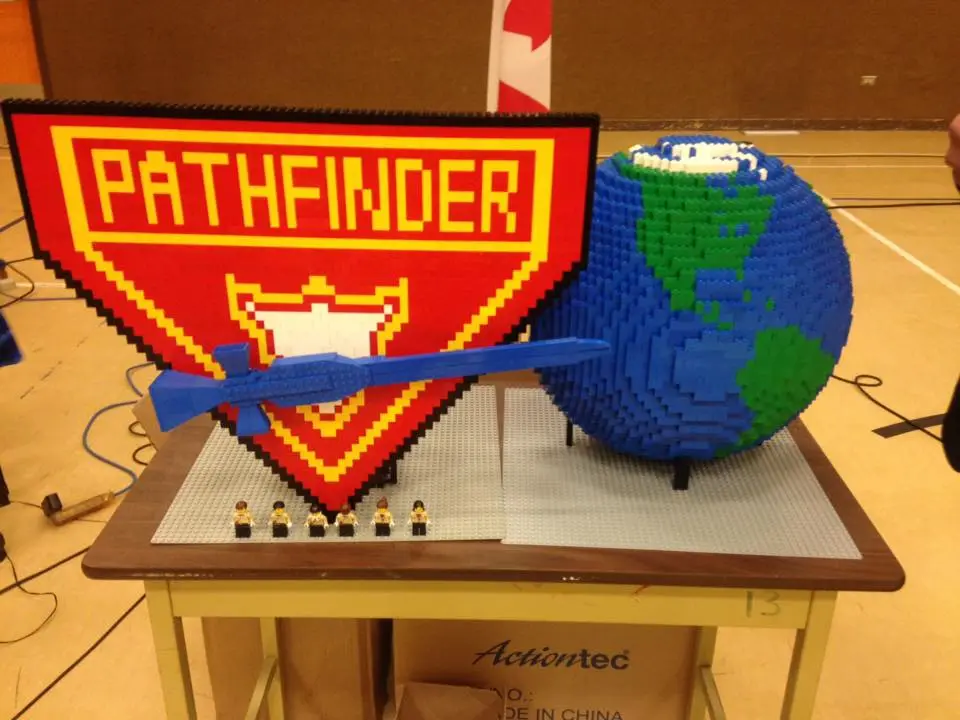
Brickshelf has a lot of amazing scale models here. Just type in the search what you are looking for.
Bricklink allows you to purchase LEGO® bricks if your looking at building a certain model. Remember to get your parent’s permission before purchasing LEGO® individually!
LDraw If you can not get access to LEGO®. This is a virtual LEGO® Program that you can use on the computer to use your imagination to build freely with.
3. Choose one of the following:
3a. Build a 1-to-1 scale model of something from nature, your home, church, or school. Then share your model with your group or club.
3b. Build a scale model of your house, apartment, or other building in your community. Be sure to include large furniture items like bed, stove, refrigerator, sofa, & dresser, etc. Then share your model with your group or club.
4. Build a scene or an item from the Bible using LEGO® in one of the scale sizes from Requirement #2.
You are working on the AY Honor Christian Storytelling honor right?
You could also include this as a way to communicate the “visual” requirement for many of the newer nature honors.
5. From your imagination create your own design, using at least 10 pieces, in 2 of the 5 categories below and share both designs with your group or club.
You can find some ideas on scenes to build on stories around the Bible at Brick Bible
5a. Car, truck, or other land vehicle.
5b. Plane, helicopter, or other aircraft.
5c. Ship, submarine, or other watercraft.
5d. Animal or plant based on a real species.
5e. Machine, appliance, or robot (without power functions)
6. Choose one of the following:
6a. Use LEGO® as visual aid in a children’s story for youth ages 2-9 at church, Sabbath School, or equivalent group setting.
6b. Use LEGO® as part of a school project.
7. Write a 250-word paragraph, or in a 3-5 minute presentation to your group or club, tell how you can use LEGO® to witness to those that don’t know about God.
Stop Motion Animation using LEGO® can be a great use to show events that happened in the Bible in a cool, fun way.–>
Note
LEGO®, the LEGO® logo and the minifigure are trademarks and/or copyrights of The LEGO® Group. Pathfinders and the Seventh-day Adventist Church are not affiliated with and/or facilitated by The LEGO® Group.
References
Adapted from AY Honors/LEGO® Design/Answer Key 2 on the Pathfinder Wiki, licensed under CC BY-SA 3.0. See the original page's history for its authors.
Found a mistake? Report it.
This is an unofficial community site. It is not affiliated with or endorsed by the General Conference of Seventh-day Adventists, the North American Division, or the official Pathfinder Wiki. Content is adapted from the Pathfinder Wiki under CC BY-SA 3.0.