
Voyager: Nature Study
Part of the Voyager class.
1a. Read a book or at least four articles on Intelligent Design in nature.
Suggested books and sources of books and articles:
- Book:Signature in the Cell: DNA and the Evidence for Intelligent Design Dr. Stephen C. Meyer received his Ph.D. from the University of Cambridge in the philosophy of science. A former geophysicist and college professor, he now directs the Center for Science and Culture at the Discovery Institute in Seattle. In 2004, Meyer ignited a firestorm of media and scientific controversy when a biology journal at the Smithsonian Institution published his peer-reviewed scientific article advancing intelligent design.
- Book:Intelligent Design: The Bridge Between Science and Theologyby William A. Dembski. Although the fast-growing movement has gained considerable grassroots support, many scientists and theologians remain skeptical about its merits. Scientists worry that it’s bad science (merely creationism in disguise) and theologians worry that it’s bad theology (misunderstanding divine action). In this book William Dembski addresses these concerns and brilliantly argues that intelligent design provides a crucial link between science and theology.
- Geoscience Research Institute
- Discovery Institute
1b. Do one of the following: Review the story of Nicodemus and relate it to the lifecycle of the butterfly. Draw a lifecycle chart of the caterpillar giving the spiritual significance. Watch a video relating to Intelligent Design and discuss its spiritual significance.
Option 1 and 2: Nicodemus was a Pharisee and a member of the Sanhedrin, who, according to the Gospel of John, showed favor to Jesus. He appears three times: the first is when he visits Jesus one night to listen to his teachings (John 3:1–21); the second is when he states the law concerning the arrest of Jesus during the Feast of Tabernacles (John 7:45–51); and the last follows the Crucifixion, when he assists Joseph of Arimathea in preparing the corpse of Jesus for burial (John 19:39–42). The John 3 verses are what this requirement is referencing.
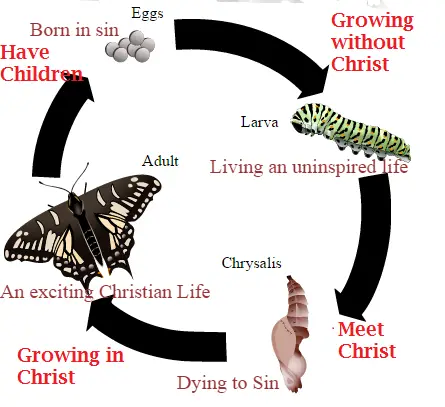
This Wikipedia article goes into great detail on the life cycle of the butterfly. The short version is that:
a) butterflies start as eggs which are tiny, round, oval, or cylindrical object, usually with fine ribs and other microscopic structures.
b) butterfly larvae, or caterpillars, consume plant leaves and spend practically all of their time in search of food. Caterpillars mature through a series of stages called instars. Near the end of each instar, the larva undergoes a process called apolysis, in which the cuticle, a tough outer layer made of a mixture of chitin and specialized proteins, is released from the softer epidermis beneath, and the epidermis begins to form a new cuticle beneath.
c) The larva transforms into a pupa (or chrysalis) by anchoring itself to a substrate and moulting for the last time. After it emerges from its pupal stage, a butterfly cannot fly until the wings are unfolded. A newly emerged butterfly needs to spend some time inflating its wings with blood and letting them dry, during which time it is extremely vulnerable to predators. Some butterflies’ wings may take up to three hours to dry while others take about one hour. Most butterflies and moths will excrete excess dye after hatching. This fluid may be white, red, orange, or in rare cases, blue.
The life cycle than repeats.
Discussion: Most species are born, breed and die. The butterfly, however, goes through a form of rebirth where it goes into a pupa before reemerging as a beautiful butterfly. Christians likewise go from uninteresting caterpillars through a transformation where they die to their old nature and emerge into a more beautiful creation of God.
Option 3: YouTube is a good source for videos on Intelligent Design, but choose wisely.
Ben Stein’s “Expelled: No Intelligence Allowed” on YouTube or Amazon is a movie about the freedom of speech suppression to which Intelligent Design proponents are being subjected to by many atheists in academia. Stein is a Jew who believes in Intelligent Design much the same way that Adventists do. This documentary is quite entertaining.
DNA By Design (2010) by Stephen C. Meyer one of the outstanding ID scientists.
Discovery Institute YouTube Channel
Discussion: If you reject Intelligent Design and believe that chance is responsible for the Universe, how can you have relationship with the God who claims to have created everything? Is God to be called a liar and then expected to save us from our sins?
2. House Plants/Butterflies Raise a plant using hydroponic principles. OR Draw, collect or photograph 10 species of butterflies, and identify correctly.
Option 1: This Wikipedia article on Hydroponics is a good place to start. Much of the information online about hydroponics is focused on cannabis cultivation, but the use of hydroponics is a perfectly acceptable method of raising many types of plants.
Option 2: Requirement 7 of the Moths and Butterflies Honor states:
Identify in the field, then draw, photograph or collect 25 species of moths and butterflies, with not more than two specimens of any one variety. When collecting, specimens should be anesthetized by using carbon tetrachloride or other chemical in collecting jar. In either project correctly label and include the following information:
a. Name
b. Date observed
c. Location
d. Time of day
e. Plant on which the insect was feeding or the material on which it was perched
Guidance:
Fulfilling this requirement is a good start on the AY Honor Moths & Butterflies For identification purposes, you will need to get a copy of a good field guide. Make sure you select one that covers the area in which you live. As with many other identification tasks, it is best to find a specimen first and then attempt to identify it, rather than going out to look for a particular specimen.
Pathfinders are encouraged to draw or photograph specimens rather than collect them. Identification should be done in the field. If going as a group, it is OK to bring one camera (perhaps the instructor’s) and then have the rest of the participants make their drawing from the pictures taken. If you have access to a digital camera and a projector, you could project a slide show and have the Pathfinders make drawings as the slides are shown. You may also print the photos and pass them around.
Advanced: Frontier Voyager
3. Complete Voyager requirements.
You must complete the requirements listed above this one on the current page.
4. Edible Wild Plants/Environmental Conservation Identify, prepare and eat 10 varieties of edible wild plants. OR Investigate and write a report on a small stream.
Option 1: This might be a good opportunity to tackle the AY Honor Edible Wild Plants where detailed guidance can be found to meet this requirement.
Option 2: This requirement matches Requirement 4 of the AY Honor Environmental Conservation where detailed instructions and tips can be found.
5. Complete a nature honor not previously earned. (Skill level 2 or 3).
Popular choices, because the major requirements are covered here, include:
AY Honor Environmental Conservation
AY Honor Moths & Butterflies (all Skill Level 2).
Here is a complete list of Nature honors at skill levels 2 and 3:
Nature Study in other classes: Friend · Companion · Explorer · Ranger · Guide
Adapted from Investiture Achievement/Voyager/Nature Study on the Pathfinder Wiki, licensed under CC BY-SA 3.0. See the original page's history for its authors.
Found a mistake? Report it.
This is an unofficial community site. It is not affiliated with or endorsed by the General Conference of Seventh-day Adventists, the North American Division, or the official Pathfinder Wiki. Content is adapted from the Pathfinder Wiki under CC BY-SA 3.0.