
Arboriculture
Overview
Arboriculture is the study, care, and management of individual trees and shrubs. This field of study is vast, misunderstood, and can be very complex. This honor is to provide Adventist youth with an opportunity to experience arboriculture with the correct information and resources. This honor is designed to be taught only by industry professionals who have several years of experience in properly instructing and representing this field of study.
Requirements
(To be taught by a certified arborist or equivalent certification)
1. Define the following terms:
- a. Arboriculture
- b. Arborist
- c. Arboriculture industry
2. Draw and identify the components of the following:
- a. Trunk cross section
- i. Outer bark
- ii. Phloem
- iii. Cambium
- iv. Sapwood (xylem)
- v. Heartwood
- b. Twig anatomy
- i. Terminal bud
- ii. Bud scales
- iii. Lateral bud
- iv. Lenticels
- v. Leaf scar
- vi. Ring of bud scale scars
- vii. Internode
- viii. Node
- ix. Bundle trace
- x. Pith
3. Name five plant characteristics used to identify trees.
4. Explain the benefits of mulching and how to properly apply it around trees and shrubs.
5. Describe the principles of water conservation and hydrozone planning.
6. The three main components of fertilizer are: nitrogen (N), phosphorus (P), and potassium (K). Explain why different ratios of these basic components would be required in different situations.
7. List five characteristics to consider when selecting trees from a tree nursery and for a planting site.
8. Interview a local certified arborist or tree expert about different planting techniques used in your area.
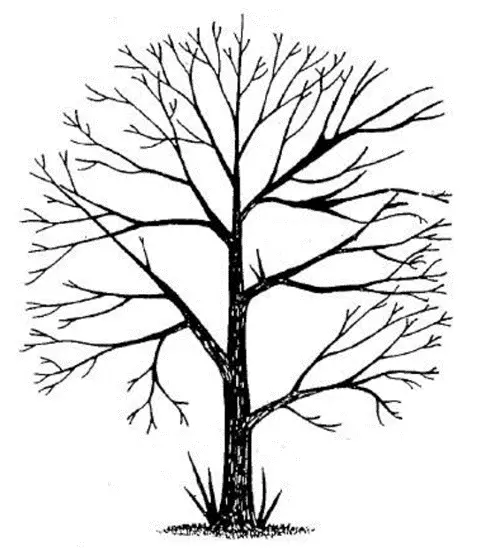
9. In the following diagram, use two different colors to identify which branches should be removed with “Thinning Cuts” or “Reduction Cuts,” and be able to explain the difference between each cut and when each cut should be used.
10. Name two types of tree support systems installed by arborists.
11. List the most common diseases, insect problems, and invasive species in your region. Categorize them by severity.
12. Understand the philosophy of Plant Health Care (PHC). Develop a PHC plan for a mature, high value tree in your area.
13. Practice filling out a commonly used Tree Risk Assessment Form for a mature tree with your instructor. As a service project, use your knowledge to fill out a form for a second tree at your school, church, or local park.
14. Research how trees can be injured or destroyed as the direct or indirect result of construction damage and present your findings to a group.
15. Give a presentation on the importance of Urban Forestry in your local rea or the nearest urban area in your region. Be creative.
16. Make a significant list of necessary Personal Protective Equipment (PPE) for conducting the following types of work: Urban Forestry, Arboriculture.
17. Be able to identify three types of ropes and tie three knots used by tree care workers.
18. Discuss the spiritual application of John 15:2 considering what you have learned in this honor.
Answer key & resources
Investiture Achievement
This honor is required, suggested or listed as an option in:
Adapted from AY Honors/Arboriculture on the Pathfinder Wiki, licensed under CC BY-SA 3.0. See the original page's history for its authors.
Found a mistake? Report it.
This is an unofficial community site. It is not affiliated with or endorsed by the General Conference of Seventh-day Adventists, the North American Division, or the official Pathfinder Wiki. Content is adapted from the Pathfinder Wiki under CC BY-SA 3.0.