
Arboriculture: Answer Key
1. Define the following terms:
1a. Arboriculture
1b. Arborist
1c. Arboriculture industry
2. Draw and identify the components of the following:
2a. Trunk cross section
2ai
Outer bark
2aii
Phloem
2aiii
Cambium
2aiv
Sapwood (xylem)
2av
Heartwood
2b. Twig anatomy
2bi
Terminal bud
2bii
Bud scales
2biii
Lateral bud
2biv
Lenticels
2bv
Leaf scar
2bvi
Ring of bud scale scars
2bvii
Internode
2bviii
Node
2bix
Bundle trace
2bx
Pith
3. Name five plant characteristics used to identify trees.
Leaves, form, bark, buds, twigs, leaves, flowers, fruit and scent are all characteristics that can be used to properly identify trees.
4. Explain the benefits of mulching and how to properly apply it around trees and shrubs.
Adding around trees can improve the soil and provide many positive effects to vegetation such as: reduced soil compaction and crusting, improved water infiltration, reduced soil erosion, decreased weed competition, consistent temperature regulations, soil structure improved over time and stabilized pH.
5. Describe the principles of water conservation and hydrozone planning.
The principles of water conservation are to evaluate the who, what, when, where, how and why of water source and use, and then develop a sustainable plan to manage this resource to better preserve the environment. One such way is creating a hydrozone plan for your site. A Hydrozone plan is simply grouping plants together based on their water needs, vegetation that requires low amounts of water should be grouped together to avoid over watering, and plants that require high amounts to avoid under watering.
6. The three main components of fertilizer are: nitrogen (N), phosphorus (P), and potassium (K). Explain why different ratios of these basic components would be required in different situations.
N = 10%, 5 kg
P2O5 = 6%, 3 kg
K2O = 4%, 2 kg
7. List five characteristics to consider when selecting trees from a tree nursery and for a planting site.
Planting site: Sunlight/shade, air pollution, rain/snowfall, buildings, future development, overhead/underground utilities, intended use of site/plant, etc.
Tree nursery: Codominant stems, wilting leaves, bad structure, broken branches, trunk wounding, soil on trunk, girdling roots, good vigor, lots of leaves, trunk taper, etc.
8. Interview a local certified arborist or tree expert about different planting techniques used in your area.
When planting a balled and burlap tree, the planting site should be inspected and markers placed for any underground utilities if present. Locate the ideal spot within the site’s restrictions and begin excavating. The planting hole should not be deeper than the height of the root ball and is preferred to be 2-3 inches shallower; however, at least 2 times wider than the root ball in order to have room to work and stabilize the tree. Once the planting hole is complete, place the tree in the center of the hole and adjust the angle to make the tree straight from all sides; pack dirt around the base to stabilize. Once the tree has been straightened and stabilized use wire cutters and utility knives to remove the top section of the basket and burlap; once removed tease roots out the ball to avoid any girdling roots in the future. Next fill in the hole around the tree and pay special attention to avoid covering the trunk. After the tree has been planted, install additional support systems only if necessary and apply mulch around the base (remember wider is better than deeper), use mulch to create a berm ring around the edge of the mulch. Finally prune any broken branches or poor structure, do not prune more than 25% of the crown.
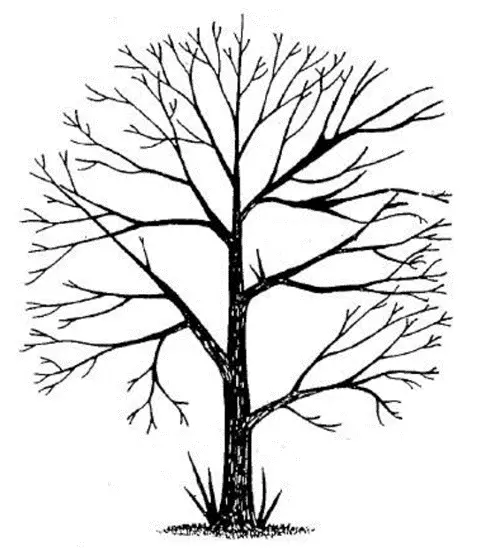
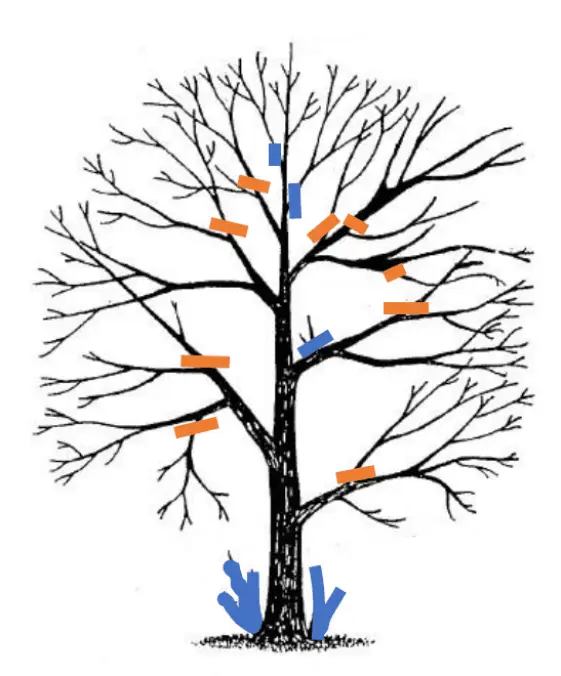
9. In the following diagram, use two different colors to identify which branches should be removed with “Thinning Cuts” or “Reduction Cuts,” and be able to explain the difference between each cut and when each cut should be used.
10. Name two types of tree support systems installed by arborists.
Cabling (static or dynamic) and bracing, guying and propping
11. List the most common diseases, insect problems, and invasive species in your region. Categorize them by severity.
This will change from region to region. Some common insects and diseases are: Emerald Ash Borer, Dutch Elm Disease, Asian Longhorn Beetle, Gypsy moth, Japanese beetles, Leaf miners, Bronze Birch Borer, Oak Wilt, Black Vine Weevil, Butternut Canker, Holly leafminer, Elm sawflies, sooty mold, etc.
12. Understand the philosophy of Plant Health Care (PHC). Develop a PHC plan for a mature, high value tree in your area.
Plant Health Care is a comprehensive program used to manage the health, structure, and appearance of plants. Best industry practices are used to ensure that the target is healthy and vigorous and that its longevity is prolonged as much as possible. In order to implement a PHC Plan arborist/assessors must know the characteristics of a healthy plant and what steps need to be taken in order to make their target plant meet that criterion. For example, arborists/assessors could prescribe structural pruning, as well as, cabling and bracing to reduce risk to public and prevent injury during wind storms. Mulching, pruning, fertilizing, cabling and bracing, pesticide application, lightning protection systems, irrigation, guying and propping, proper species and site selection are all practices that could be implemented in a PHC Plan.
13. Practice filling out a commonly used Tree Risk Assessment Form for a mature tree with your instructor. As a service project, use your knowledge to fill out a form for a second tree at your school, church, or local park.
14. Research how trees can be injured or destroyed as the direct or indirect result of construction damage and present your findings to a group.
Construction damage is very common in tree mortality, especially in new developments. A lot of engineers and construction workers are not well versed on the complexity of trees and their preservation. It is important for an arborist to be involved in the earliest planning stages of the project in order to help preserve high value trees.
Most construction site damage is caused by the operation of heavy machinery which can damage bark, branches, or roots. Storage of equipment and supplies can compact soil crushing or suffocating tree roots, which will eventually lead to tree mortality. Excavation and grading are also leading causes of tree injury during construction. Injuries may not kill the tree right away but may compromise the tree’s ability to fight off pests and disease due to the increase of stress from construction.
15. Give a presentation on the importance of Urban Forestry in your local rea or the nearest urban area in your region. Be creative.
Here are some topics and information to assist in writing your report: Trees can improve moods, save energy, absorb excess water, block unwanted views, reduce crime rates, increase property value, reduce heating/cooling cost and usage, purify air, manage soil erosion, provide food and shelter for wildlife, store carbon emissions, and much more.
You might also be interested in completing the AY Honor Forestry Honor.
16. Make a significant list of necessary Personal Protective Equipment (PPE) for conducting the following types of work: Urban Forestry, Arboriculture.
Urban Forestry: Hard hat, certified work boots, adequate hearing protection, certified eye protection, Hi-Vis vest.
Arboriculture: Certified chainsaw protection rated pants/chaps, gloves, boots, and gloves. Climbing hard hat, adequate hearing and eye protection, Hi-Vis shirt/vest, proper clothing for work type. All tree climbing equipment and safety equipment must follow local regulations.
17. Be able to identify three types of ropes and tie three knots used by tree care workers.
18. Discuss the spiritual application of John 15:2 considering what you have learned in this honor.
Every branch in Me that does not bear fruit He takes away; and every branch that bears fruit He prunes, that it may bear more fruit.
— John 15:2 (NKJV)
References
Adapted from AY Honors/Arboriculture/Answer Key on the Pathfinder Wiki, licensed under CC BY-SA 3.0. See the original page's history for its authors.
Found a mistake? Report it.
This is an unofficial community site. It is not affiliated with or endorsed by the General Conference of Seventh-day Adventists, the North American Division, or the official Pathfinder Wiki. Content is adapted from the Pathfinder Wiki under CC BY-SA 3.0.